


Crude Drugs

Plant Details
Plant ID
PLN009
Crude Drug ID
CRD4
Plant Name
Saraca asoca
Common Name
Ashoka tree
Scientific Name
Saraca asoca
Vernacular Name
Ashok, Ashopalava, Ashoka, Ashokam, Hemapushpam
Plant Description
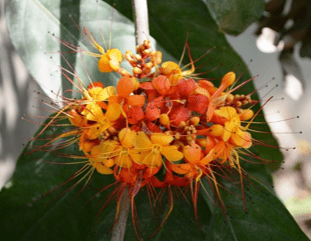
The Saraca asoca tree, often referred to as the ashoka tree (meaning "sorrow-less"), is a member of the Detarioideae subfamily within the legume family. It holds significant cultural importance in the traditions of the Indian subcontinent and neighboring regions. Despite occasional misidentification as Saraca indica, it remains a prominent botanical feature. Notably, the flower of the Ashoka tree holds the distinction of being the state flower of Odisha, a state in India.
Plant Classification
Kingdom
Plantae
Phylum
Streptophyta
Class
Magnolipsida
Order
Fabales
Family
Fabaceae
Genus
Saraca
Species
asoca
Variety/Line/Chemotype
Distribution
The ashoka is a rain-forest tree. Throughout India, except Northwestern India, up to 750 m. Its original distribution was in the central areas of the Deccan plateau, as well as the middle section of the Western Ghats in the western coastal zone of the Indian subcontinent.
Use
Bark—uterine tonic (imparts healthy tone to uterus), used for suppressed menses, leucorrhoea, menstrual pain, menorrhagia, complaints of menopause. Also used for dyspepsia, biliousness, colic, burning sensation. Flowers—pounded and mixed with water, used in haemorrhagic dysentery, bleeding piles and retention of urine.
Chemical Constituents
The bark yields alkanes, esters and primary alcohols. It gave n-octacosanol, tannins , catechin, (+)-catechol, (−)-epicatechin, (−)-epicatechol, leucocyanidin, leucopelargonidin, procyanidin derivatives, methyl-and ethylcholesterol derivatives. The flowers contain fatty acids and gallic acid; apigenin-7-O-beta D-glucoside,cyanidin-3,5-diglucoside, kaempferol 3-O-beta-D-glucoside, pelargonidin-3,5-diglucoside, quercetin.
Drug Part :
Stem bark
Habbit
Small tree
Chemical Constituents 12
The bark yields alkanes, esters and primary alcohols. It gave n-octacosanol, tannins , catechin, (+)-catechol, (−)-epicatechin, (−)-epicatechol, leucocyanidin, leucopelargonidin, procyanidin derivatives, methyl-and ethylcholesterol derivatives. The flowers contain fatty acids and gallic acid; apigenin-7-O-beta D-glucoside,cyanidin-3,5-diglucoside, kaempferol 3-O-beta-D-glucoside, pelargonidin-3,5-diglucoside, quercetin.
Bark—uterine tonic (imparts healthy tone to uterus), used for suppressed menses, leucorrhoea, menstrual pain, menorrhagia, complaints of menopause. Also used for dyspepsia, biliousness, colic, burning sensation. Flowers—pounded and mixed with water, used in haemorrhagic dysentery, bleeding piles and retention of urine.
Flower anticancer, anti-inflammatory, uterine tonic activity, CNS depressant, analgesic, antiulcer and larvicidal activities
Polyalthia longifolia
Trunk often tubercled; bark lenticellate, dark, shallowly fissured; blaze purplish. Leaves compound, paripinnate, alternate, distichous; stipules caducous; rachis pulvinate, 7-30 cm long; petiolule 0.1-0.6 cm long; leaflets opposite, 4-6 (-12) pairs, lamina 6-31 x 1.5-9 cm, narrow elliptic-oblong or lanceolate, apex acute to acuminate, base acute to rounded or subcordate, subcoriaceous, glabrous; midrib raised above; secondary nerves ca. 11 pairs, looped; tertiary nerves reticulate. Inflorescence dense corymbs; flowers orange, sometimes white; fragrant. Pod, flat, oblong, to 15 x 4.5 cm, apiculate; seeds obovate-orbiculate.
Stem bark: Stem barks are channeled, about 4-5 mm thick, curved, some pieces are straight. Outer surface rough, cracks irregular, circular lenticels present externally grayish brown and inner surface reddish brown in color. Fracture splintery. Odorless and astringent in taste.
Stem bark: T.S. of bark shows outer periderm made up of wide zone of 10-12 celled thick cork and radially elongated 4-5 celled thick cork cambiums. Secondary cortex made up of thin walled cells having stone cells and yellow masses of parenchymatous cells. Prismatic crystals also distributed in this region. Secondary phloem made up of phloem parenchyma, sieve tube and companion cells. Medullary rays uni- triiseriate. Phloem fibers present in groups and prismatic crystals present around these fiber bundles. Starch grains also seen in the secondary cortex region.
Visual: Reddish- brown to light brown Taste: Astringent odour : characteristic Texture : Fibrous
Total Ash 9.24 ± 0.04 Acid-insoluble ash 1.05 ± 0.02 Sulphated ash 11.10 ± 0.30 Water soluble extractive 24.06 ± 1.250 Hydro-alcohol soluble extractive 25.50 ± 0.50 Alcohol soluble extractive 18.12 ± 0.34 *Value in percent (dry weight basis)
Descriptive Part
Crude Drugs
| ID | Drug Part Name | |
| CRD4 | Stem bark |
Transcriptome
| Transcriptome ID | Transcriptome Name | |
| TPT2 | D |