


Crude Drugs
Plant Details
Plant ID
PLN001
Crude Drug ID
CRD3
Plant Name
Andrographis paniculata
Common Name
Green chiretta
Scientific Name
Andrographis paniculata
Vernacular Name
Kalmegh
Plant Description
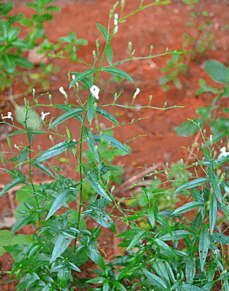
The plant grows as an erect herb to a height of 30–110 cm (12–43 in) in moist, shady places. The slender stem is dark green, square in cross-section with longitudinal furrows and wings along the angles. The lance-shaped leaves have hairless blades measuring up to 8 cm (3.1 in) long by 2.5 cm (0.98 in). The small flowers are pink, solitary, arranged in lax spreading racemes or panicles. The fruit is a capsule around 2 cm (0.79 in) long and a few millimeters wide.
Plant Classification
Kingdom
Plantae
Phylum
Streptophyta
Class
Magnolipsida
Order
Lamiales
Family
Acanthaceae
Genus
Andrographis
Species
paniculata
Variety/Line/Chemotype
Distribution
The species is distributed in tropical Asian countries, often in isolated patches. It can be found in a variety of habitats, such as plains, hillsides, coastlines, and disturbed and cultivated areas such as roadsides and farms. Native populations of A. paniculata are spread throughout south India and Sri Lanka which perhaps represent the center of origin and diversity of the species. The herb is an introduced species in northern parts of India, Java, Malaysia, Indonesia, the West Indies, and elsewhere in the Americas. The species also occurs in the Philippines, Hong Kong, Thailand, Brunei, Singapore, and other parts of Asia where it may or may not be native. The plant is cultivated in many areas, as well.
Use
A. paniculata has also traditionally been used in India and China for the common cold and influenza. A 2017 (pre COVID-19) meta-analysis evaluating Andrographis paniculata for acute respiratory tract infections (ARTI) indicated possible support for its efficacy and safety, but cautioned that the trials reviewed were of poor quality and thus not conclusive.
Chemical Constituents
Drug Part :
Aerial Part
Habbit
Annual erect herb.
Chemical Constituents 12
Andrographolide, neoandrographolide, homoandrographolide, andrographosterol, andrographane, andrographone, andrograpanin, andrographin, dihydroxy-di-methoxyflavone, andrographoside, andropaniculosin, isoandrographolide andrographatoside
In traditional Chinese medicine it is an important herb used to release body heat in fever, effectively used as immunostimulant and for asthma, gonorrhea, piles, dysentery and dyspepsia, blood purification, influenza, gastric complaints, diarrhea, fever, loss of scalp hair, snake bite, myocardial ischemia, common cold, diabetes, respiratory tract infection, jaundice. The species also possesses antiulcerogenic , antityphoid, antiplatelet aggregation, anti HIV, antimalarial, antifertility, antihyperglycemic properties.
Andrographis paniculata shows different important medicinal activities like Anti-inflammatory, antioxidant, antidiabetic, antileishmanial, antivenom, anti-HIV, antidiarrhoeal, antifertility, anticancer activity, antimalarial, antibacterial, hepatoprotective, antimicrobial, antifungal activities and helpful in cardiovascular and immunological diseases.
Annual, erect, herb, about 40 to 80 cm. Stems quadrangular, multi-branched, branches knob point slightly inflated, easily broken. Leaves opposite; lanceolate to long elliptic, apex acuminate, base cuneate, margin shallow undulate, both surfaces glabrous, dark green above, gray-green below; petiole short or sub-sessile. Inflorescence terminal and axillary racemes; bracts and bracteoles small, lanceolate; Calyx 5-parted, outside covered with glandular hairs; corolla purplish white, bilipped, upper lip and outside bracteoles small, lanceolate; hairy. Capsule flat, oblong, about 1cm long, slightly glandular. Seeds square shape, small and red.
Aerial Part: Plant is herbaceous, up to 50 cm tall, annual, much branched. Leaves are 4-8cm x 1.5-2.5 cm in size, opposite, ovate-lanceolate to lanceolate, or narrowly elliptic, margin entire, apex acute to shortly acuminate; surface glabrous, lower surface pale green, upper surface green. Stem is green, quadrangular shape, glabrous; flowers are Axial, purplish white; fruits are capsule, oblong, about 1 cm. odour characteristic, taste bitter.
Leaf Midrib: Triangular shaped midrib. The epidermis is made up of columner cells. Upper epidermal cells are covered with cuticle. Upper bulge is filled with varying size of collenchyma cells. In lower bulges, epidermis is followed by 1-2 layers of collenchyma cells. Vascular bundle semilunar shaped, lies in centre of midrib. Vascular bundle is conjoint, collateral, endarch and closed. Leaf Lamina: Below the upper epidermis there is single layer of elongated palisade cells containing chlorophylls are present. Below palisade cells spongy parenchyma cells are present in the lamina. Stem: Stem quadrangular in shaped. Four bulges are present at each corner which are formed by collenchyma cells. Epidermis is made up of cubical to rectangular cells and covered with cuticle. Several collenchyma cell zones with secretary cavity are present beneath the epidermis which is filled with white colour deposition. Cortex is formed by narrow zone of 5-6 layers of parenchyma cells filled with chloroplasts. Solitary sclereids or single layer sclereids in groups are present in the inner side of cortex. Single layer of endodermis is present inner to the cortex. Pericycle is thin walled with paricyle fibres. Below the pericycle phloem is present. Xylem is very prominent and occupies the major portion of the stem. Vessels are mostly solitary. Pith consists of parenchymatous cells containing needle shaped
Visual: light green Taste: bitter odour: characteristic
Total Ash: 8.27 ± 0.05 Acid-insoluble ash: 1.03 ± 0.04 Sulphated ash: 12.19 ± 0.20 Water soluble extractive: 23.88 ± 1.30 Hydro-alcohol soluble extractive: 25.95 ± 0.60 Alcohol soluble extractive: 16.13 ± 0.45 *Value in percent (dry weight basis)
Descriptive Part
Crude Drugs
| ID | Drug Part Name | |
| CRD3 | Aerial Part |
Transcriptome
| Transcriptome ID | Transcriptome Name | |
| TPT1 | leaf |