


Chemical Molecules

Molecule Details
| Molecule ID | MOL80 | ||
| Compound Name | alpha-Muurolene | ||
| ⤓Download 2D Structure File | ⤓Download 3D Structure File | View Structure Image |
Structure Image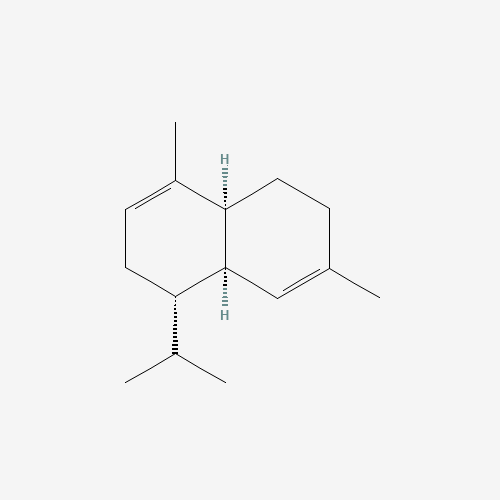
|
Primary Details
| Compound Name | alpha-Muurolene |
| Synonym Name | alpha-Muurolene, Muurolene, 10208-80-7, D2ZGB75M36, alpha-Muurolene, (-)- |
| CAS ID | 10208-80-7 |
| IUPAC Name | (1S,4aS,8aR)-4,7-dimethyl-1-propan-2-yl-1,2,4a,5,6,8a-hexahydronaphthalene |
| Molecular Formula | C15H24 |
| Chemical Safety | Irritant, flammable |
| External Database ID |
12306047 |
| Inchi | InChI=1S/C15H24/c1-10(2)13-8-6-12(4)14-7-5-11(3)9-15(13)14/h6,9-10,13-15H,5,7-8H2,1-4H3/t13-,14+,15-/m0/s1 |
| INCHI Key | QMAYBMKBYCGXDH-ZNMIVQPWSA-N |
| Canonical SMILES | CC1=CC2C(CC1)C(=CCC2C(C)C)C |
| Molecule Type | Natural |
| Group | Phytochemicals |
| Sub-Group 1 | Terpenoids (Isoprenoids) |
| Sub-Group 2 | sesquiterpenoid |
| Sub-Group 3 | - |
| Sub-Group 4 | - |
| Sub-Group 5 | - |
| Description |
The sesquiterpene alpha-muurolene is 1,2,4a,5,6,8a-hexahydronaphthalene. Methyl groups (the 1S,4aS,8aR-diastereoisomer) substitute at position 1 and at positions 4 and 7. It is a carbobicyclic chemical and a sesquiterpene. |
Chemical & Physical Properties
| Molecular Weight | 204.35Â g/mol |
| LogP (Octanol-Water) | 4.1 |
| Hydrogen Donor Count | 0 |
| Bond Acceptor Count | 0 |
| Rotable Bond Count | 1 |
| Topological Surface Area | 0 |
| Heavy Atom Count | 15 |
| Melting Point | |
| Boiling Point | |
| Water Solubility | |
| Henry's Law Constant | |
| pKa Dissociation Constant | |
| Vapour Pressure | |
| Molecule Density | |
| Molecule Stability | |
| Kovats retention Index | |
| Physical Description |
|
Spectra Information
Biological Activities
| Activity Name | antibacterial, antibiofilm, anticancer activity and anti-iflammatory |
| Molecule Target | |
| Comment |
|
| References |
1. Xiong, G., Wu, Z., Yi, J., Fu, L., Yang, Z., Hsieh, C., ... & Cao, D. (2021). ADMETlab 2.0: an integrated online platform for accurate and comprehensive predictions of ADMET properties. Nucleic acids research, 49(W1), W5-W14. 2. Kim, S., Chen, J., Cheng, T., Gindulyte, A., He, J., He, S., ... & Bolton, E. E. (2019). PubChem 2019 update: improved access to chemical data. Nucleic acids research, 47(D1), D1102-D1109. 3. Jang, H. I., Rhee, K. J., & Eom, Y. B. (2020). Antibacterial and antibiofilm effects of α-humulene against Bacteroides fragilis. Canadian journal of microbiology, 66(6), 389–399. https://doi.org/10.1139/cjm-2020-0004 4. Legault, J., & Pichette, A. (2007). Potentiating effect of beta-caryophyllene on anticancer activity of alpha-humulene, isocaryophyllene and paclitaxel. The Journal of pharmacy and pharmacology, 59(12), 1643–1647. https://doi.org/10.1211/jpp.59.12.0005 5. Fernandes, E. S., Passos, G. F., Medeiros, R., da Cunha, F. M., Ferreira, J., Campos, M. M., Pianowski, L. F., & Calixto, J. B. (2007). Anti-inflammatory effects of compounds alpha-humulene and (-)-trans-caryophyllene isolated from the essential oil of Cordia verbenacea. European journal of pharmacology, 569(3), 228–236. https://doi.org/10.1016/j.ejphar.2007.04.059 |